
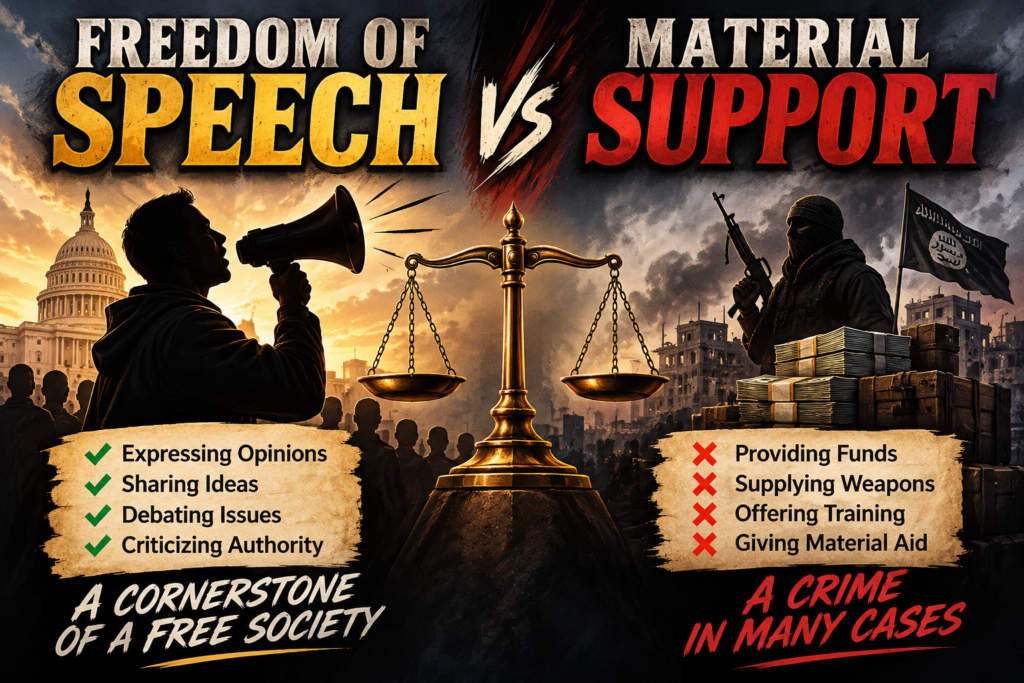
In the United States, we are (allegedly) granted the Freedom of Religion as well as the Freedom of Speech in the 1st Amendment of the Constitution. This is the law, whether we believe in man-made law or not.
It is not illegal to have opinions and express them. Supporting mujaahideen groups by simply expressing your opinion in favor of them is not illegal.
What is illegal is when it falls into Material Support.
What is Material Support? See the AI-summarized definition in layman’s terms below:
From ChatGPT:
“Terrorist Material Support: An Overview of 18 U.S.C. § 2339A and § 2339B.”
It’s a legal overview of two federal laws that allow the U.S. government to prosecute people and organizations for providing support to terrorism.
The important thing to understand right away is that you do not necessarily have to participate in terrorism, commit violence, or even agree with a terrorist organization’s ideology to potentially violate these laws. Providing certain kinds of assistance can itself be a federal crime.
I’ll break down what the laws actually prohibit, what counts as support, what the differences are between the two statutes, and where the legal boundaries are.
1. There are two separate laws
Although they are closely related, they target two different kinds of assistance.
| Law | What it prohibits |
|---|---|
| 18 U.S.C. § 2339A | Providing assistance knowing or intending that it will be used to commit certain specified crimes, including terrorism-related offenses. |
| 18 U.S.C. § 2339B | Knowingly providing assistance to a foreign terrorist organization (FTO). |
The distinction is important.
Section 2339A: The government must establish that you knew or intended your assistance to be used in connection with a qualifying crime.
For example: Someone knowingly supplies explosives to a group because they intend the group to use them in a terrorist bombing.
Section 2339B: The government does not have to prove that you intended to help the organization carry out a terrorist attack. It must establish that you knowingly provided material support to an organization covered by the law and knew the relevant facts about its terrorist designation or activities.
For example: Someone knowingly sends money to a designated foreign terrorist organization, even if they claim the money was intended for the organization’s nonviolent activities.
That second provision is particularly significant because it doesn’t require prosecutors to prove that the particular donation was intended to finance violence.
2. What actually counts as material support?
This is probably the most important section of the report.
The law defines material support extremely broadly. It includes virtually any tangible or intangible property or service.
Examples include:
-
Money and financial donations.
-
Banking and financial services.
-
Housing or lodging.
-
Transportation.
-
Weapons and explosives.
-
Communications equipment.
-
Safe houses.
-
False identification documents.
-
Specialized technical or professional assistance.
-
Training and instruction.
-
Providing personnel or individuals to work for an organization.
There are two notable statutory exceptions:
-
Medicine.
-
Religious materials.
In other words, the law doesn’t just target people supplying weapons or financing attacks.
Someone providing technical expertise, transportation, housing, or other services could potentially fall under these statutes.
An important distinction: The law’s broad definition doesn’t mean that every interaction with someone associated with a terrorist organization is illegal. The other requirements of the applicable statute still have to be met.
3. Does the person have to support terrorism ideologically?
No.
This is one of the more consequential aspects of § 2339B.
The government doesn’t have to establish that someone:
-
Agrees with the organization’s ideology.
-
Wants the organization to commit terrorist attacks.
-
Personally supports terrorism.
-
Intends their particular contribution to facilitate violence.
Instead, the government must establish that the person knowingly provided material support and knew the relevant facts about the organization’s terrorist status or activities.
This is why someone might theoretically face prosecution for providing assistance they believe is humanitarian or otherwise nonviolent.
The Supreme Court addressed this issue in Holder v. Humanitarian Law Project (2010).
The case involved Americans who wanted to provide training and assistance to designated foreign terrorist organizations on peaceful activities, including using international law to resolve disputes.
The Supreme Court upheld the application of § 2339B to the coordinated assistance at issue.
The Court distinguished between independently expressing support for an organization and providing services to that organization.
That distinction is critical.
4. What about freedom of speech?
The report spends considerable time addressing the First Amendment.
The government cannot simply criminalize someone’s political opinions, religious beliefs, or independent advocacy because those opinions happen to favor a terrorist organization.
For example, there is an important legal distinction between:
-
Expressing support for a political movement.
-
Publishing an article defending an organization’s political positions.
-
Criticizing the U.S. government’s foreign policy.
-
Advocating for a designated organization’s removal from a terrorist list.
And:
-
Providing the organization with money.
-
Coordinating services with its leadership.
-
Training its members.
-
Providing personnel or specialized assistance.
The first group generally involves constitutionally protected expression. The second can constitute prohibited material support.
The Supreme Court’s ruling in Humanitarian Law Project established that coordinated services to a designated organization aren’t automatically protected just because the services are intended to advance peaceful objectives.
Essentially: You can express your opinions about an organization, but you cannot necessarily provide that organization with assistance just because you believe your assistance serves a peaceful purpose.
5. What if someone is only attempting to provide support?
They don’t necessarily have to succeed.
Both statutes cover:
-
Actually providing material support.
-
Attempting to provide material support.
-
Conspiring with others to provide material support.
This is significant because the government doesn’t necessarily have to wait until money changes hands or assistance is delivered.
For example, someone who enters into an agreement to provide assistance to a terrorist organization could potentially be prosecuted even if the assistance is never delivered.
An attempt also requires more than simply thinking about committing a crime. Generally, prosecutors must establish criminal intent and a substantial step toward completing the offense.
6. What are the penalties?
Section 2339A
15 years
Maximum imprisonment
Section 2339B
20 years
Maximum imprisonment
If someone dies as a result
Both statutes can carry life imprisonment when the offense results in death.
Other consequences can include substantial fines and, in certain circumstances, civil lawsuits brought by victims of international terrorism.
The penalties shown are maximums, not automatic sentences.
7. Does this apply outside the United States?
Yes, potentially.
The report explains that § 2339B contains provisions allowing prosecution for certain conduct occurring outside the United States.
For example, U.S. citizens can potentially be prosecuted for providing material support to foreign terrorist organizations even when the assistance is provided overseas.
Section 2339A also has potential extraterritorial application, depending on the underlying offense involved.
This means these laws aren’t necessarily limited to activities taking place on American soil.
8. Who decides which organizations are terrorist organizations?
For purposes of the formal Foreign Terrorist Organization designation discussed in § 2339B, the Secretary of State makes the designation under the Immigration and Nationality Act.
The designation process is important because it gives the organization a specific legal status under U.S. law.
However, there’s another interesting wrinkle: § 2339B also refers to organizations that the defendant knows engage or have engaged in terrorism or terrorist activity. The statute isn’t limited to simply knowing that an organization appears on the formal designation list.
My overall takeaway
There are five major things I’d take away from this report:
1. Material support is incredibly broad. It isn’t limited to giving money or weapons. It can include transportation, housing, technical expertise, training, and other services.
2. You don’t have to participate in violence. Someone can potentially violate these laws by providing assistance without personally committing or participating in a terrorist attack.
3. Intent matters, but differently under each law. Under § 2339A, the government must establish knowledge or intent that the assistance will be used in connection with a qualifying crime. Under § 2339B, the government doesn’t have to establish that you intended to further the organization’s terrorist activities.
4. Humanitarian intentions aren’t automatically a defense. Even assistance intended to accomplish peaceful objectives can be prohibited when coordinated with a designated foreign terrorist organization.
5. Political and religious expression are not automatically illegal. Expressing support for a group, discussing its ideology, criticizing American foreign policy, or advocating for a political cause is fundamentally different from providing material support.
One particularly important distinction
I want to emphasize something because I think it’s easy to misunderstand these laws.
Consider three hypothetical situations:
| Situation | General legal distinction |
|---|---|
| Someone publicly expresses support for Hamas’s political positions. | Generally protected speech. |
| Someone independently publishes articles arguing that Hamas should be removed from the FTO list. | Generally protected advocacy. |
| Someone knowingly transfers money to Hamas, claiming it’s intended exclusively for humanitarian activities. | Potentially criminal material support under § 2339B. |
The third example is particularly important. The law doesn’t generally allow individuals to bypass the material-support prohibition by deciding that their contribution will only benefit the organization’s supposedly legitimate activities.
There are separate humanitarian exceptions and authorization mechanisms in certain circumstances, but they aren’t a blanket exemption for private donations.
However, there is also the case of our brother Abu Hamza from Tennessee, may Allah hasten his release.
- The Defendant: Benjamin Alan Carpenter (also known as Abu Hamza) from Knoxville, Tennessee, an American citizen who converted to Islam.
- The Charges & Conduct: Carpenter founded and operated Ahlud-Tawhid Publications. He was charged with attempting to provide material support to a designated foreign terrorist organization (ISIS) under 18 U.S.C. § 2339B. Instead of participating in physical violence, his involvement consisted of translating, publishing, and distributing pro-ISIS pamphlets, articles, and media weekly summaries into English for international distribution.
- The Legal Battle: Carpenter argued that his actions were purely religious and ideological expressions protected under the First Amendment, asserting that the material support statute did not cover basic translation work.
- The Outcome: The federal courts rejected this defense. In a decision upheld by the U.S. Court of Appeals for the Sixth Circuit, judges ruled that translation services fit explicitly within the statutory definition of providing a “service” to a terrorist organization when done in coordination with or to advance the group’s agenda.
The short answer is that Carpenter’s case sits right on the boundary between constitutionally protected expression and criminal assistance to a designated terrorist organization. And the distinction the government relied on is more specific than simply saying he published pro-ISIS material.
There is an important detail in this case that I think is worth understanding: he wasn’t ultimately convicted merely for expressing support for ISIS or publishing religious or political opinions. He was convicted for attempting to provide translation services directly to ISIS.
Let’s break that down.
1. What did Benjamin Carpenter actually do?
Benjamin Carpenter, also known as Abu Hamza, was the founder of Ahlut-Tawhid Publications, a group that translated and distributed ISIS material.
According to the prosecution:
-
He translated ISIS propaganda from Arabic into English.
-
He published a newsletter called From Dabiq to Rome.
-
He produced material praising ISIS and its ideology.
-
He communicated with someone he believed was affiliated with ISIS leadership.
-
He accepted translation assignments intended for ISIS’s official media operation.
That last point was particularly important.
The person communicating with him was actually an undercover FBI agent posing as an ISIS affiliate. Carpenter believed he was providing translation work for ISIS’s media organization.
The government charged him under 18 U.S.C. § 2339B, which prohibits knowingly providing material support to a designated foreign terrorist organization.
2. Why wasn’t this protected by freedom of speech?
This is where the Supreme Court’s 2010 decision in Holder v. Humanitarian Law Project becomes important.
The Supreme Court established a distinction between two activities:
| Constitutionally protected | Potentially criminal |
|---|---|
| Independently expressing support for ISIS | Providing services to ISIS |
| Writing articles criticizing U.S. foreign policy | Translating material at ISIS’s request |
| Discussing Islamic political or religious ideas | Coordinating propaganda projects with ISIS |
| Publishing your own opinions | Working under the direction of ISIS |
The important distinction is independent advocacy versus coordinated assistance.
The Supreme Court said people remain free to express support for a designated terrorist organization, discuss its ideology, and advocate for its political objectives independently.
But providing services to that organization, in coordination with it or at its direction, can be criminalized—even if those services involve speech or intellectual work.
That’s the constitutional framework the Sixth Circuit applied to Carpenter.
3. What about his pamphlets and newsletters?
This is an important distinction that I don’t want to gloss over.
Carpenter’s newsletter, From Dabiq to Rome, and his other publications were part of the government’s evidence.
However, his actual conviction was based on attempting to provide translation services to ISIS.
The prosecution argued that he wasn’t simply independently publishing material that happened to support ISIS. He was coordinating with someone he believed represented ISIS leadership, accepting assignments, organizing translators, and returning completed translations for ISIS’s use.
The FBI agent requested a translation of an ISIS propaganda video, told Carpenter that ISIS leadership needed it, and received the completed translation.
Carpenter subsequently accepted another assignment before his arrest.
The fact that the supposed ISIS representative was actually an undercover FBI agent didn’t eliminate the attempted-support charge. Carpenter believed he was working for ISIS.
4. Does freedom of religion change anything?
There is another important part of the statute: 18 U.S.C. § 2339A actually excludes religious materials from its definition of material support.
But that doesn’t mean everything produced or distributed for religious reasons is exempt.
For example:
-
Translating the Quran independently: protected religious activity.
-
Publishing Islamic theological commentary: protected expression.
-
Criticizing American foreign policy from an Islamic perspective: protected expression.
-
Independently publishing controversial political or religious material: generally protected.
-
Providing translation services directly to ISIS as part of its media operation: potentially criminal under § 2339B.
The government doesn’t get to eliminate someone’s First Amendment rights simply because they’re Muslim, hold unpopular religious beliefs, or sympathize with a controversial organization.
The legal issue is the nature of the assistance and its relationship to the designated organization.
5. What happened to Carpenter?
This case has actually progressed beyond the initial conviction:
-
March 2021: Arrested and charged.
-
October 2023: Convicted by a jury.
-
July 2024: Sentenced to 20 years in federal prison.
-
October 31, 2025: The Sixth Circuit Court of Appeals affirmed his conviction and sentence.
The appellate court specifically concluded that translation services qualified as services under the material-support statute.
You can read the full appellate decision here:
United States v. Carpenter (Sixth Circuit, 2025).
My takeaway
I think your original question raises a legitimate constitutional concern.
There is a meaningful difference between:
-
A Muslim publishing religious or political material that happens to be favorable to ISIS.
-
A Muslim independently translating ISIS publications because he believes people should have access to that material.
-
A person coordinating translation projects directly with ISIS representatives to provide a service to the organization.
Those situations aren’t necessarily legally equivalent.
The Supreme Court’s distinction between independent advocacy and coordinated assistance is particularly important because otherwise the government could potentially criminalize an enormous amount of political and religious expression.
One thing I’d emphasize: You don’t have to support ISIS, agree with Carpenter’s beliefs, or approve of his publications to be concerned about the boundaries of First Amendment protections.
That’s precisely why these constitutional distinctions matter. They protect unpopular expression, not just expression that most Americans happen to agree with.
As much as it pains me to say, if anyone claiming to be from Dawlah reaches out to you and asks you to do anything, they are almost certainly a federal agent and you are almost certainly being set up.
In summary, you are welcome to speak freely here. Having and expressions opinions is not illegal. However, if you post anything here that constitutes material support, I will be forced to remove it. I’m not going to prison because of some dumbasses on the internet. Please, use your brain, be careful, and have common sense.
THIS ONLY APPLIES TO THE US, I CANNOT SPEAK FOR OTHER COUNTRIES. I AM NOT A LAWYER AND THIS IS NOT LEGAL ADVICE. WHEN IN DOUBT, CONSULT A LAWYER.
BaarakAllahu Feekum.